
Ey yo.. what’s up? 😊
Welcome to my blog!
We’re almost at the finish line baby.. Big Win! Join me for a rhymeee;
All shame
Lives on the other side of fear
Wrong blame
Mandem draw 9 beers
‘Ugly’, ‘lame’, outlaws shunned to tears
Wild, insane.. throw it asylum or lairs
Lighting the abyss
Illuminates all despair
Shadows & denying
Disgrace thick in’e air…
What comes to mind when you see these words?
Ugly, bad, shameful, weird, taboo, socially unacceptable, shunned, denied, reject, envy, greed
There’s an umbrella term in psychology they use:
Shadow/Shadow Self

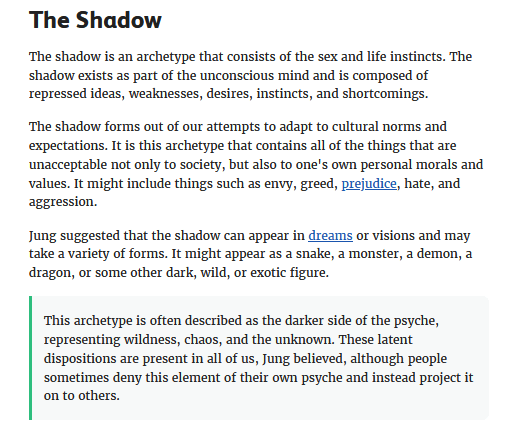
The Shadow
From Wikipedia – the long version;

But this is the fuller explanation that I like:
These are things we view as either unflattering (envy, greed, cruelty, power, sexuality), or unfamiliar (defying culture or expectations).
You should hopefully know by now, everything we know, until a point of self-awareness, is everything we were taught to know through socialisation –
As we grow up, we’re taught that certain emotions and/or behaviours are good, whereas others, such as anger, envy, expressing sexuality etc are bad. Everything that we reject or are taught to reject falls into our shadow, neatly out of conscious and awareness; it doesn’t mean these things go away, however.
For example, as a child, you may be taught that jealousy/envy is a bad emotion and instead of learning how to manage it or understand what the emotions mean, you instead learn to discard it into your shadow. Growing up means realising that jealousy isn’t a bad emotion, but human and normal, and can point towards where you may need to make changes in your own life.
Jealousy and envy are only bad if they create malicious intentions that one wilfully acts upon, especially if never taught how to feel and handle them.
Okay, back to the point.
The central idea is what is out of our conscious. The unknown.
There’s also the idea of fear central to our thoughts about anything unknown. Fear is fundamentally encoded in our DNA, to help us survive and avoid uncertainty. It shows up as adrenaline or fits of anxiety and triggers, but living by fear and to survive closes you off from experiences and influences how you interact with people.
To put this into context,
The psychological term for fear of the unknown is “xenophobia.”
Fear can be internal, occurring as anxiety or safeguarding ‘false’ beliefs, or external, arising as xenophobic violence.
And what do we fear?
When you really look at the grand scheme of things, it can be so many things; failure, divorce, interacting with/being druggies, being viewed as aggressive, being an outcast etc, because maybe we’ve been socialised to view them as shameful, promoting disregard and stigma.
Disregard?
What you perceive negatively will form a trigger in seeing it in others, so you’ll blame and shame.
The Four Major Jungian Archetypes
‘Archetypes are universal, inborn models of people, behaviors, or personalities that play a role in influencing human behavior. They were introduced by the Swiss psychiatrist Carl Jung, who suggested that these archetypes were archaic forms of innate human knowledge passed down from our ancestors.’
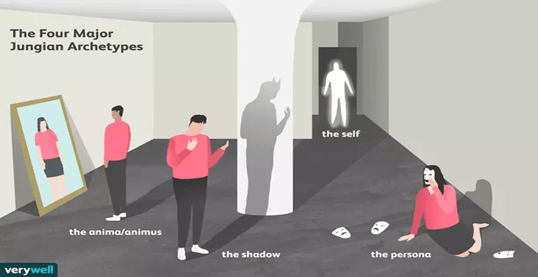
So according to Jung, the four main influential archetypes are the self, the persona (mask we show to the world), the shadow and the anima/animus.
Third time’s a charm. Do you see a mirage?
The persona is the mask we show people, and it counters our shadow, which is everything we’d like to keep hidden, which may even be hidden from our conscious as well, and, may be the truer versions of who we really are.
Repression leads to projection.
The fight between the mask and shadow ultimately leads to projecting the parts of ourselves we deny – what provokes us about other people points to something unresolved within us.
Issues from projection
There are two components to issues regarding not welcoming/understanding your shadow:
- Harshly judging and finding wrong in others, even where there is no wrong except from own prejudice.
- Using judgements and shadow expectations to attempt to control other people or their behaviours e.g. shaming in families
Real Life?
In family
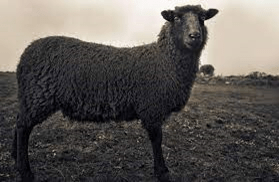
(And if you’re part of this squad, I’m sorry for what you go through.. wishing you love 🥺)
The phrase originates from a recessive gene that resulted in black rather than white sheep, and so they stood out. Black sheep doesn’t even always mean a bad child or qualities, it can even be being more adventurous than the rest of the family, or being a remarkable creative in a family of outstanding scientists etc.
The term when disparaging however shows larger dysfunctional patterns in family as one person evolves as the scapegoat for a long line of personal projections, rejections and lack of acceptance, for fear of losing culture and defying expectations.
The many psychological effects of rejecting misunderstood children in family can’t even be unpacked here bo’babes.. Ebile when I bear in mind people always say children are blessings, and realise just how shitty humans are at raising those little humans in their most important development years, hai hai, cima cima le’camera yoo.. making my blood boil 😠
And even the seemingly ‘troublesome’ black sheep is most likely only so because of being outcast from the get-go, and experiencing hurt and loneliness.
In society
Many things I can think of, but I’ll consider two topics. Firstly:
Slut-shaming: the practice of criticizing people, especially women and girls, who are perceived to violate expectations of behavior and appearance regarding issues related to sexuality.
In the paper ‘’Good Girls’’: Gender, Social Class, and Slut Discourse on Campus, its argued (convincingly) that most slut shaming by women occurs due to issues of classism and portraying power dynamics, (since the girlies resist expectations.)
In shadow psychology, that would mean ‘first party’ violates ‘other party’ expectations about how women should act or carry themselves sexually. Hence, the ‘other party’ unconsciously comprehends it as depiction (or lack thereof) of class, power and, purity and worthiness of respect.
It’s possibly all boiling down to a denial of something that they may also feel and loathe seeing in others, and/ or projecting weak ideas they’ve been indoctrinated to hold that give them a sense of worthiness.
LGBTQ+ 🏳️🌈
Most shaming of this community occurs due to cultural and religious expectations of what sex and relationships should look like based on socialisation. For men, you’ll find their projection results from their father’s actively teaching them that men can’t be gay, showing them to be sadistic to the LGBTQ+ community that doesn’t conform to what they’ve always known.
For others, people, it can be projections of having those same unwanted feelings for the same sex, that leads to blame and shame in others who accept themselves.
In Conclusion
Do your shadow work.
Oh, I almost forgot! Today we celebrate victory as the Botswana Court of Appeal has upheld the ruling that decriminalised same-sex relationships 🥳🥳🥳🥳🌈🌈🌈🌈🌈❤️❤️❤️❤️ A re nkao tempela 🥳 …… Pel’🎉
The end :))
Thanks for reading, I hope you enjoyed! See you next month for a finale!
 Alleta With A Letter